Habit design · 12 min
Why saying your meal — then asking USDA — is the calorie log people actually keep
Most trackers fail at the same step: you hunt a database while the plate is still warm. DietPal splits that job. You speak. USDA FoodData Central does the math.
September 2026 · Estimates for awareness, not a lab analysis.
If you have ever opened a calorie app, searched “chicken,” and scrolled twelve identically named entries, you already know why logging dies. The science on tracking is not mysterious. The interface is.
Takeaways
- People who keep a food record tend to lose more weight — and they only keep the record if it is fast.
- Searching a branded database is where most trackers quit. Speech names the plate in one breath.
- Calories should come from USDA FoodData Central, not a photo guess. Linked papers are at the bottom.
The habit that actually moves the number
Weight-management research keeps landing on the same behavior: self-monitoring — writing down what you ate. A systematic review by Burke, Wang, and Sevick in the Journal of the American Dietetic Association (2011) found a consistent association between monitoring food intake and weight loss. People who keep a record tend to do better than people who do not.
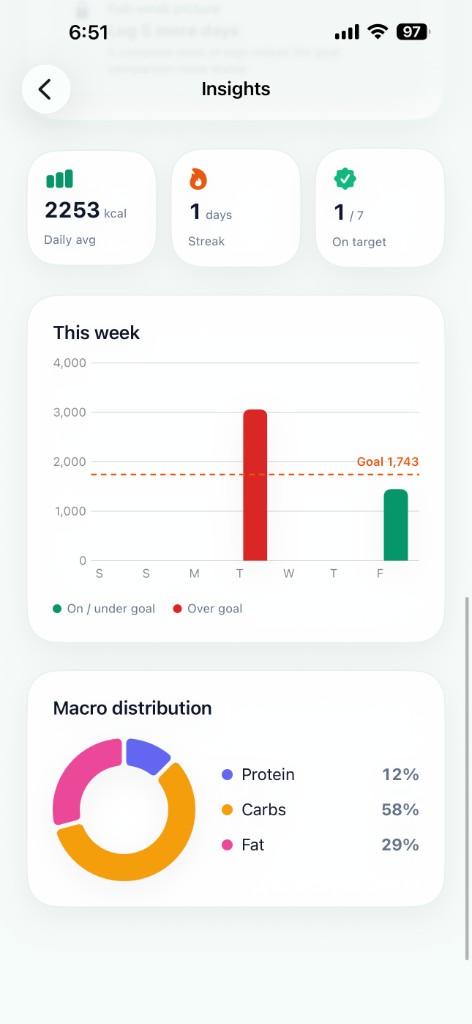
Frequency matters more than a perfect diary. A 2016 meta-analysis by Harkin and colleagues in Psychological Bulletin found that monitoring progress toward a goal — including diet — helps people actually reach it. The Weight-Loss Maintenance trial similarly found that people who recorded more often lost more weight during the intensive phase (Hollis et al., 2008). DietPal’s week board is built on that: three logged days beat a flawless spreadsheet you abandon on Thursday.
Behavior-change science names the same lever. Michie and colleagues’ Behavior Change Technique Taxonomy (2013) lists self-monitoring of behavior as a core technique — not shame, not a lecture, a record.
“The tracker you keep is the one that fits between the last bite and the next meeting.”
Where people quit: the database hunt
Traditional apps make you become the search engine. Brand names, cooking fat, homemade versus restaurant. Each extra tap is a chance to close the app.
Mobile diary studies keep showing the same pattern: the people who log more often are the people who stick. Turner-McGrievy and colleagues compared paper diaries with a mobile app in JAMIA (2013) and found more frequent self-monitoring with the phone. A later review of smartphone apps that support dietary self-regulation (Semper, Povey, and Clark-Carter, 2016) is cautious — apps help when they make monitoring easier, not when they add more screens.
Speech does not magically know calories, and DietPal does not pretend a recording is a lab. Speech only does the part humans are already good at: naming the plate in the time it takes to say it.
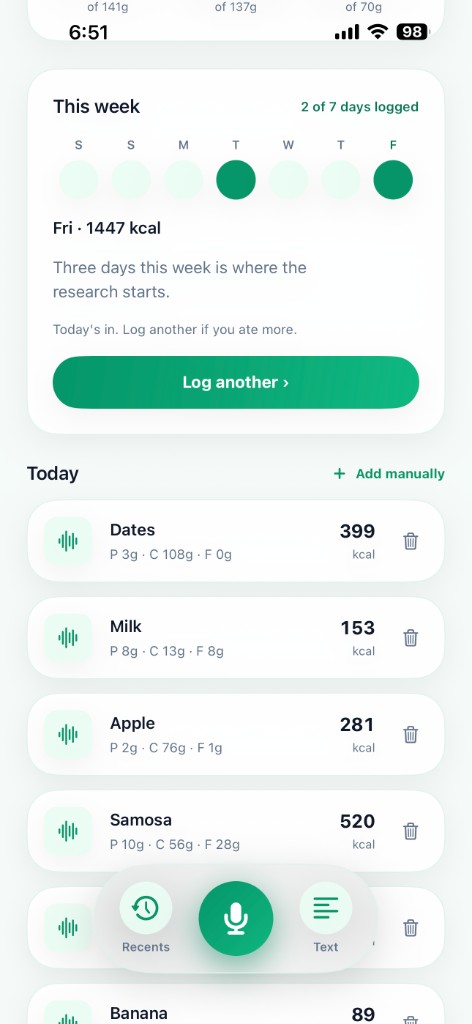
“Dates, milk, an apple, a samosa, a banana.” That sentence is a complete log attempt. Typing it into a food database is five separate searches.
1. Audio in
Up to 60 seconds. Transcribed, then the file is deleted.
2. USDA lookup
Calories and macros from FoodData Central, scaled to the portion.
3. Log stays
Names, grams, macros remain. Recents copy them with no extra AI.
Why the numbers should be USDA — not a photo model
USDA FoodData Central is the U.S. Department of Agriculture’s public nutrient database. Each food carries energy and macros per 100 grams. Dietitians use it; the Dietary Guidelines for Americans sit on the same scientific stack. DietPal’s job after transcription is unglamorous on purpose: identify the foods, pick a portion in grams, look up USDA, store the result on your log.
If USDA has no match, we use DietPal’s dish table. Estimate is last resort, and the row says so. We do not infer calories from a photo, and we do not make you scan a barcode to start the day.
That split — voice for capture, USDA for nutrition — is the product. Audio is a pipe. After we have the text, the clip goes away. What you keep is a meal you can edit, re-log from Recents, and chart across the week.
What testers actually use — not invented ratings
DietPal does not publish fake star scores or user counts. The proof is the product: USDA first, a deleted clip, seven free AI logs a month, unlimited manual, Skip for now on the paywall.






People logging meals out loudSpeak it. USDA fills the log.
- Between meetings: “Salmon, rice, side salad.” Sixty seconds. Then you walk away.
- Same breakfast again: Recents copy stored USDA macros. No second AI pass.
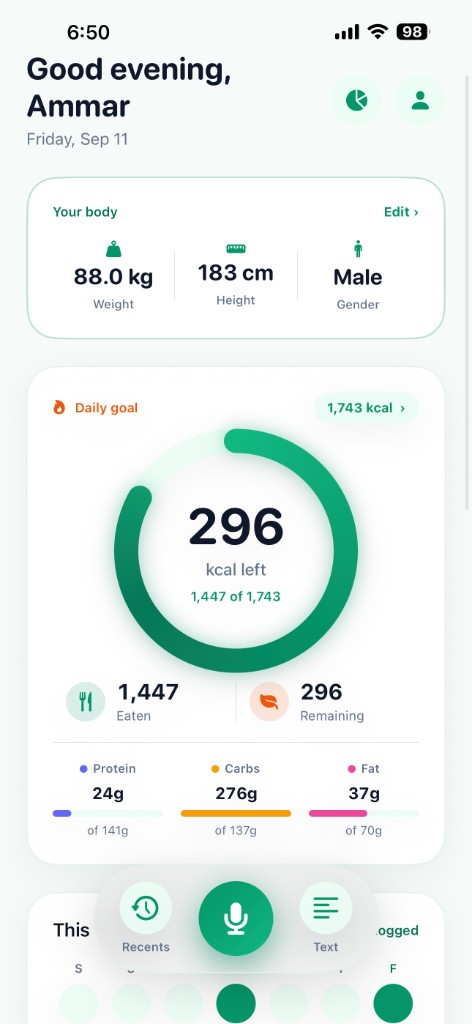
- No lecture: a ring for the day. Weekly trends when you ask.
How DietPal applies the research
Easy to start is not the same as easy to retain. A barcode scanner feels precise until you cook at home. A photo guess feels modern until dinner is a mixed plate. A branded database feels complete until you say “dahi” or “samosa.”
Retention is friction. If logging costs less attention than the meal, you will do it tomorrow. Combined with USDA, a short voice note is the lowest-friction path we know that still grounds calories in a public dataset you can inspect.
DietPal is not a clinical trial. Estimates are for awareness. The research we trust is simpler than marketing: people who keep monitoring tend to do better — and they only monitor if the log takes seconds.
References
- Burke LE, Wang J, Sevick MA. Self-monitoring in weight loss: a systematic review of the literature. J Am Diet Assoc. 2011;111(1):92-102. PubMed 21185970 · doi:10.1016/j.jada.2010.10.008
- Hollis JF, Gullion CM, Stevens VJ, et al. Weight loss during the intensive intervention phase of the weight-loss maintenance trial. Am J Prev Med. 2008;35(2):118-126. PubMed 18617354
- Harkin B, Webb TL, Chang BPI, et al. Does monitoring goal progress promote goal attainment? A meta-analysis of the experimental evidence. Psychol Bull. 2016;142(2):198-229. PubMed 26479070
- Michie S, Richardson M, Johnston M, et al. The behavior change technique taxonomy (v1) of 93 hierarchically clustered techniques. Ann Behav Med. 2013;46(1):81-95. PubMed 23512508
- Turner-McGrievy GM, Beets MW, Moore JB, et al. Comparison of traditional versus mobile app self-monitoring of physical activity and dietary intake among overweight adults. J Am Med Inform Assoc. 2013. PubMed 23429607
- Semper HM, Povey R, Clark-Carter D. A systematic review of the effectiveness of smartphone applications that encourage dietary self-regulatory strategies for weight management. 2016. PubMed 27192018
- USDA Agricultural Research Service. FoodData Central. fdc.nal.usda.gov
- U.S. Department of Agriculture & U.S. Department of Health and Human Services. Dietary Guidelines for Americans. dietaryguidelines.gov